

Selling an Apartment During Divorce 2026 | Practical Guide
During a divorce, there are usually three ways to deal with an apartment: one spouse buys out the other, the apartment is sold and the money is divided, or the dispute is resolved in court. If the apartment is joint property, it is generally divided in equal shares unless the parties agree otherwise. If there is a mortgage, the bank must be involved because the loan agreement is not changed automatically. A quick sale may be suitable when both sides need a fast and discreet solution.
Introduction
Divorce is difficult even when there is not much property to divide. When the shared home is an apartment, the situation often becomes more complicated. One spouse may want to stay in the apartment, while the other wants to receive their share in money. Sometimes neither spouse wants to keep the apartment, but both still need to agree on the sale.
The hardest part is not always the legal side. Often, the bigger problem is communication. An apartment cannot be divided like a bank account. Its value must be established, the loan must be dealt with, and the parties must reach a clear agreement before going to the notary.
This guide explains:
what happens to an apartment during divorce;
when an apartment is joint property and when it is separate property;
the three main options;
what to do if the apartment has a mortgage;
when tax and legal issues may arise;
how to reduce disputes and keep the process as calm as possible.
Important note: this article is for general information and does not replace legal advice. Divorce, division of property, and loan obligations depend on the specific facts. Before signing an agreement, speak with a family law lawyer, attorney, or notary.
Apartment and divorce — the legal framework
Joint property and separate property
If spouses have not chosen another property regime and have not signed a matrimonial property agreement, the default regime in Estonia is generally community of property. This means that property acquired during the marriage usually belongs to both spouses jointly.
Joint property may include:
an apartment bought during the marriage, even if only one spouse is listed as the owner in the land register;
property bought with joint funds;
improvements that increased the value of the apartment and were made with joint money or joint work;
rights and obligations connected with managing joint property.
Separate property is usually:
property that belonged to one spouse before the marriage or before the community property regime began;
property received by one spouse as a gift or inheritance;
property that a matrimonial property agreement defines as separate property;
money received from selling separate property, or new property bought with that money, if this can be proven.
The family home rule is also important. In some cases, the other spouse’s consent may be needed even if the apartment is separate property, but it is used as the family home.
Matrimonial property agreement
A matrimonial property agreement can change the whole picture. It may set out separation of property, a set-off of assets acquired during marriage, or state that a specific apartment belongs only to one spouse.
If you have a matrimonial property agreement, do not assume that the apartment is automatically divided equally. First, review the agreement and, if needed, ask a notary or attorney for advice.
How divorce affects the apartment
Divorce ends the community property regime. After that, the joint property must be divided. If the parties agree, this can be done through a notarial agreement. If there is no agreement, either spouse can ask the court to divide the joint property.
The general rule is simple: joint property is divided in equal shares unless the spouses agree otherwise. In practice, the outcome may be affected by contributions made from separate property, loan obligations, children’s living arrangements, and other circumstances.
3 main options for the apartment
Option 1: one spouse buys out the other
This is suitable when one person wants to stay in the apartment and can pay the other spouse for their share.
How it works:
The market value of the apartment is established. If needed, a valuation report is ordered.
The remaining loan balance and other agreed liabilities are deducted.
One spouse pays the other spouse for their share.
The bank confirms whether the loan can be changed.
The notary formalizes the ownership change and the agreement.
Example:
Apartment market value: €150,000
Remaining loan balance: €60,000
Net value of the apartment: €90,000
Each spouse’s share under a 50/50 split: €45,000
If the husband keeps the apartment, takes over the loan, and the bank agrees, he pays the wife €45,000. If there is no loan, half of the value would be €75,000.
Pros:
one spouse can stay in the home;
the apartment does not need to be sold publicly;
the process can be quick if the money and the bank’s consent are available.
Cons:
the buyout requires money or an additional loan;
the bank may not agree to transfer the loan to one person;
there may be a dispute over the apartment’s value.
Suitable when:
one spouse wants to keep the apartment;
the other is willing to receive their share in money;
the bank’s conditions can be met.
Option 2: sell the apartment together and divide the money
This is often the clearest solution. The apartment is sold, the loan is repaid, and the remaining money is divided according to the agreement.
How it works:
You agree on the sale method: broker, self-sale, or direct buyer.
You set the price and sale terms.
The loan and transaction costs are paid first from the sale proceeds.
The remaining amount is divided according to the agreement, usually 50/50.
The notary formalizes the transaction and the division of money.
Example:
Sale price: €150,000
Loan balance to the bank: €60,000
Amount left after repaying the loan: €90,000
Under a 50/50 split, each spouse receives €45,000
Pros:
neither spouse has to buy out the other;
both receive money for a new start;
the loan can be repaid from the sale proceeds;
after the transaction, the property issue is usually clearer.
Cons:
cooperation is needed for the sale;
one spouse may delay the process;
public sale can be emotionally difficult;
selling may take several months.
Suitable when:
neither spouse wants to keep the apartment;
both want a financial settlement;
communication is calm enough to complete the sale process.
Option 3: there is no agreement and the matter goes to court
If the parties cannot agree, either spouse can ask the court to divide the joint property. The court can decide how the property is divided, whether the apartment is sold, and how the parties’ claims are taken into account.
Pros:
a decision can be made even if the other side does not cooperate;
the court can resolve complex disputes;
the judgment gives a clear basis for the next steps.
Cons:
court disputes are expensive;
proceedings may take a long time;
stress is higher;
the outcome may not be ideal for either side;
the process is less private than a notarial agreement.
Suitable when:
the other spouse refuses all cooperation;
there is a serious dispute over the value of the property or contributions;
a peaceful agreement is no longer possible.
Special situation: an apartment with a mortgage
A mortgage makes divorce more complicated because the bank is involved. Ownership of the apartment and the bank loan are not the same thing. The apartment may be joint property, but the loan agreement must be reviewed separately to see who is liable to the bank.
Important rules
1. Ownership and loan liability are different things
If the apartment is joint property, its value must be taken into account when the property is divided. But the people liable to the bank are those who are borrowers or co-borrowers under the loan agreement. If only one spouse took the loan, this does not always mean that the other spouse is equally liable to the bank. However, the loan may still affect the value and division of the joint property.
2. The bank does not release anyone automatically
If both spouses are parties to the loan agreement, divorce does not release one of them from the loan. The bank assesses whether the person keeping the apartment can pay the loan alone. If the bank does not agree, another solution is needed.
3. The simplest solution is often a sale
If the apartment is sold, the loan can be repaid from the sale proceeds. This usually ends the shared loan obligation if the sale price covers the loan balance and the bank confirms the release of the mortgage.
Example with a mortgaged apartment
Situation: - The apartment was bought during the marriage - Market value in 2026: €170,000 - Remaining loan balance: €80,000 - Net value: €90,000 Option A: one spouse keeps the apartment - The bank must agree to change the loan - The spouse staying in the apartment takes over the loan alone - The other spouse receives half of the net value: €45,000 Option B: the apartment is sold - Sale price: €170,000 - Loan repaid: €80,000 - Remaining amount: €90,000 - Under a 50/50 split, each spouse receives €45,000
If the bank does not agree to change the loan
If the bank decides that one spouse cannot service the loan alone, the buyout may not work. In that case, there are usually three options:
ask another bank for an offer;
add a co-borrower or guarantor, if the bank allows it;
sell the apartment and repay the loan from the sale proceeds.
Tax and legal aspects
Income tax on the sale of an apartment
When spouses divide property between themselves, this is not the same as a normal sale to a third party. The tax treatment still depends on the form of the transaction, how the property was used, and whether taxable gain arises.
If the apartment is sold to a third party, it must be checked whether the gain is tax-exempt or taxable. If the apartment was used as the seller’s home until the sale, the sale of the home may be exempt from income tax. As a general rule, this exemption can be used for one home sale within two years.
If the exemption does not apply, the gain is taxed at the applicable income tax rate. In 2026, the personal income tax rate in Estonia is 22%.
For tax questions, ask an accountant, tax adviser, or the Estonian Tax and Customs Board before the sale.
If there are children
Having children does not automatically mean that the apartment cannot be sold. But children’s living arrangements may affect who uses the apartment temporarily and when it is reasonable to move forward with the sale.
If the dispute reaches court, the court may take the children’s interests and the family’s real situation into account. This can make the process longer and more sensitive.
Out-of-court agreement and mediation
Not every dispute has to go to court. Sometimes a neutral mediator can help. A mediator does not decide for the parties, but helps them reach an agreement.
Mediation may work when communication is poor, but both sides want to avoid court. It is usually faster and more private than court proceedings.
Quick sale during divorce — when does it make sense?
A quick sale to a direct buyer may be a good solution when both sides want to close the apartment issue quickly. It is not always the way to get the highest price. A public sale may bring a better price, but it usually takes more time and requires more communication.
A quick sale may be suitable when the priorities are:
Speed — the transaction may take weeks, not months.
Discretion — the apartment does not need to be listed publicly.
Less coordination — fewer viewings and fewer agreements to manage.
A clear financial end — both sides receive their share quickly.
Less pressure — the sale process does not drag on alongside the divorce.
Possible process
Day 1: both spouses give basic consent to the sale. If needed, the buyer communicates with each spouse separately.
Days 2–4: the buyer inspects the apartment and asks for the necessary documents.
Days 5–7: the offer is sent to both parties in writing.
Days 7–10: if the offer is acceptable, the transaction terms are agreed.
Days 10–14: the notary prepares the transaction. If needed, one spouse gives a notarized power of attorney.
Days 14–17: the money is transferred according to the notarial agreement.
Notarized power of attorney
If one spouse cannot or does not want to come to the notary, they may give a notarized power of attorney to another person. This may be an attorney, family member, or another trusted person. The power of attorney must be precise enough for the notary to complete the transaction.
Common problems when selling an apartment during divorce
Problem 1: one spouse does not agree to the sale
First, try a written agreement, mediation, or communication through attorneys. If that does not work, it is possible to go to court and request the division of joint property.
Problem 2: there is a dispute over the apartment’s value
Order an independent valuation report. If trust is very low, each side may order their own valuation and then agree on an average or use a third expert.
Problem 3: one spouse lives in the apartment and the other cannot access it
In this case, the parties need to agree on rules for use. If there is no agreement, the question of use or access can be resolved through court.
Problem 4: the loan cannot be changed
The bank checks payment ability, collateral, and risk. If the bank does not agree, a buyout may not be possible. It is then usually sensible to discuss a sale or refinancing.
Problem 5: children attend a local school
School, kindergarten, and the children’s daily routine may affect the timing of the sale. This does not mean that the apartment automatically remains unsold for years. But it is worth making a realistic agreement: for example, who lives in the apartment until a certain date and how the other spouse’s share will be compensated later.
Frequently asked questions
Is the apartment always joint property if we bought it during marriage?
Generally yes, if the community property regime applies and the apartment is not separate property by exception. Exceptions may include inheritance, a gift, or a matrimonial property agreement.
What happens to an apartment bought before marriage if the loan was paid during marriage?
This needs separate analysis. The apartment may remain one spouse’s separate property, but loan payments or improvements made during the marriage may give the other spouse a compensation claim. Ask a lawyer for advice.
If the loan is in my name, can I sell the apartment without my spouse’s consent?
Usually not if the apartment is joint property or used as the family home. The loan agreement and ownership are different things. The notary checks whose consent is needed.
How long does division of joint property take in court?
It depends on the complexity of the dispute. A simpler case may end within months; a complex dispute may take years. The more property, loans, and objections there are, the longer the process usually takes.
How much does an attorney cost in a divorce and property division case?
It depends on the amount of work. A simple agreement may cost much less than a long court dispute. In practice, costs may range from a few thousand euros to tens of thousands if the dispute lasts a long time.
Can we sell the apartment before the divorce is officially final?
Yes, if the required consents are in place and the notary can formalize the transaction. Divorce and sale of the apartment do not always have to happen at the same time.
What happens if one spouse dies during the divorce process?
The situation then becomes a succession matter. It must be checked whether the marriage was still valid, whether there is a will, and what belongs to the joint property. In that case, speak with a notary or a succession law specialist.
Can the apartment be sold through a quick sale during divorce?
Yes, if both parties agree or their representatives have valid powers of attorney. All important terms must be written down, and the notary formalizes the transaction.
Is a quick sale discreet?
Yes, compared with a public sale, it is usually more discreet. The apartment does not need to be listed on portals, and there are fewer viewings.
Does the money always have to be divided 50/50?
Not always. If the apartment is joint property, equal division is the general rule. The parties may agree on a different split. In special cases, contributions from separate property, liabilities, and other claims may also matter.
Summary
Selling an apartment during divorce — 5 practical rules:
Find out whether the apartment is joint or separate property. Do not rely only on the land register entry.
Review the loan agreement. The bank does not release anyone from the loan automatically.
Establish the apartment’s value. A valuation report helps reduce disputes.
Prefer a written agreement. Court is needed when no agreement is possible.
Choose the sale method according to the situation. A quick sale offers speed and privacy; a public sale may bring a higher price.
Need help selling an apartment during divorce?
We have experience with situations where an apartment is sold during divorce or property division. We can help when both sides want a fast and discreet solution.
We offer:
a free initial consultation;
separate communication with both spouses, if this helps reduce tension;
a clear written offer to both parties;
a discreet transaction without a public listing;
support with the notary and document preparation;
division of the money according to the notarial agreement.
Fill in the form and get an offer
Read More
Selling inherited property between several heirs in Estonia 2026
Inherited an Estonian apartment with other heirs? How co-heirs sell, split the proceeds, what it costs and what to do if one refuses. Offer within 24 hours.
Read moreInheritance procedure in Estonia 2026: steps, time and cost
How the notarial inheritance procedure works in Estonia: 1 to 3 months, about €206 in fees, when you can sell the apartment. Offer within 24 hours.
Read more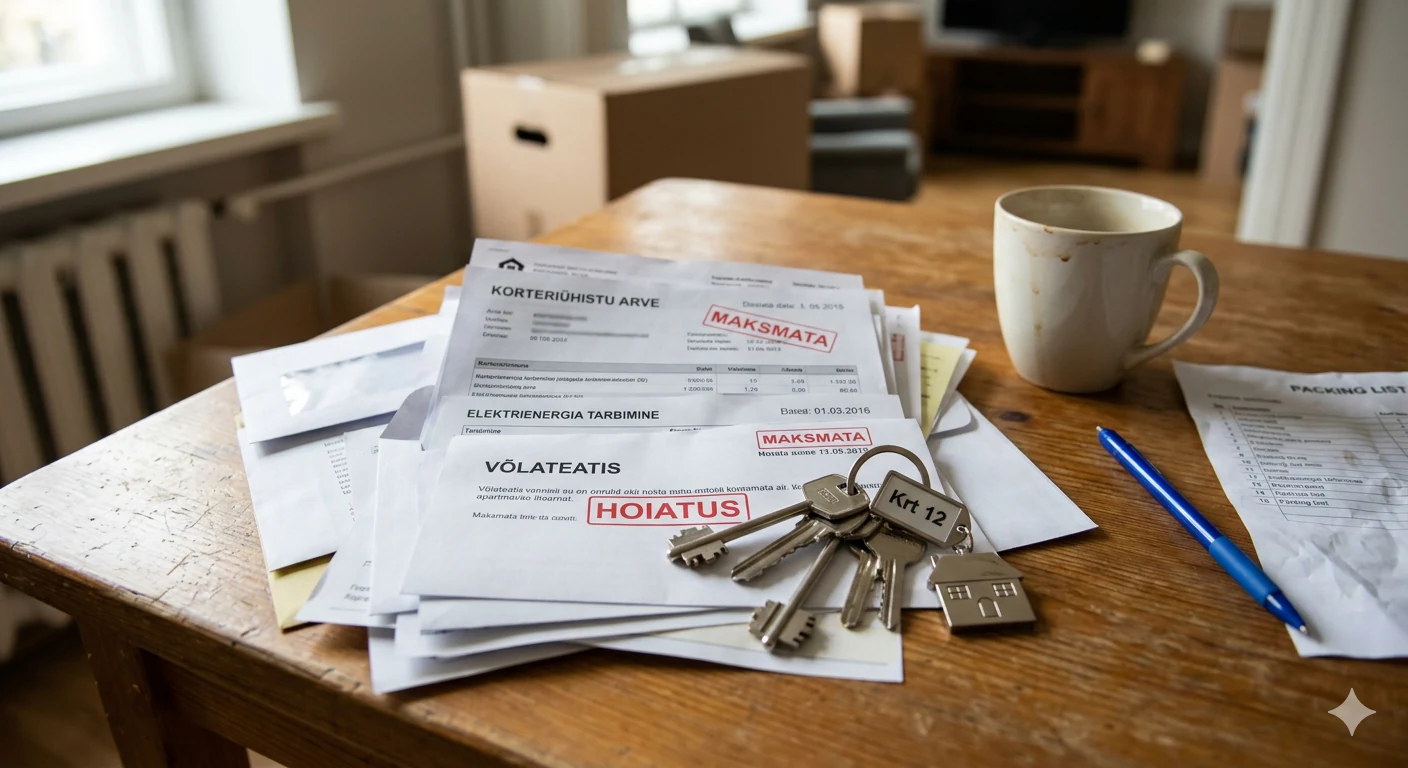
Apartment with debt 2026 | How to avoid a forced sale
Have debts attached to your apartment? Learn how to sell before a forced sale and settle creditors during the transaction.
Read more