

Inherited apartment - 7 Steps from succession to sale
In Brief
Selling an inherited apartment requires 7 steps: (1) contacting a notary to initiate succession proceedings, (2) waiting for the certificate of succession (3-6 months), (3) reaching an agreement with co-heirs, (4) assessing the condition of the apartment, (5) choosing the sale method (broker vs direct buyer), (6) completing the notarial transaction, (7) accounting for income tax in the following year's tax return. The entire process from the deceased person's death to receiving the money typically takes 4-8 months.
Introduction
When someone close to you passes away and leaves an apartment behind, you are often dealing with a double burden: grieving the person while also having to handle bureaucracy, rights, obligations and often co-heirs. The actual sale of the apartment is usually the final step in a long process.
This guide explains the full journey from the deceased person's death to the money arriving in your account. We cover both practical steps and common traps that may arise when selling an inherited apartment.
Important note: Succession law in Estonia is regulated by the Succession Act (RT I 2008, 7, 52). In a specific situation, we always recommend consulting a notary or an attorney specialising in succession law.
Basics of succession law in Estonia
Before moving on to the steps, it is useful to know a few basic principles:
Who is an heir?
Estonian law distinguishes between two bases of succession:
Succession by will - the deceased person has left a written will
Intestate succession - if there is no will, the estate is divided between legal heirs
Order of legal heirs:
1st order: children (including grandchildren if the child has passed away)
2nd order: parents (if there are no children)
3rd order: grandparents and their descendants
The spouse inherits together with the heirs of the first two orders (the exact shares depend on the specific situation).
What are succession proceedings?
Succession proceedings are a formal process carried out by a notary, as a result of which the heir receives a document (certificate of succession) proving their right to the estate. Without it, the notarial transaction for selling the apartment cannot be completed.
7 steps - from inheritance to sale
Step 1: Initiating succession proceedings (week 1)
After the deceased person's death, you need to:
Obtain a death certificate (from the vital statistics office)
Contact a notary (the notary office of your choice)
Submit an application for succession proceedings
The heir must do this within 10 years after the deceased person's death (limitation period for the right of succession). In practice, it makes sense to do it immediately, because before the succession proceedings are completed, the rights related to the apartment cannot be changed.
Required documents:
Your identity document
The deceased person's death certificate
Proof of family relationship (birth certificate, extracts from the vital statistics office)
Existing will (if any)
Cost: Initiating succession proceedings at the notary costs €100-300
Step 2: Waiting for the succession proceedings (3-6 months)
The notary publishes a notice about the opening of the estate in Ametlikud Teadaanded (ametlikudteadaanded.ee). The purpose of this is to:
Give other possible heirs the opportunity to come forward
Allow creditors to submit their claims
Waiting period: Under Estonian law, 6 months after the publication of the notice. During this period, the following may appear:
Additional heirs you were not aware of
The deceased person's creditors (loans, debts, unpaid bills)
During this period, you cannot sell the apartment, because you are not yet the official owner.
Practical advice: Use the waiting period to assess the apartment's condition, organise documents and think through the sale method.
Step 3: Receiving the certificate of succession and reaching an agreement with co-heirs (month 6-7)
When the succession proceedings end, the notary issues a certificate of succession. This is a document that proves your right to the estate.
If you are the sole heir: You become the full owner of the apartment. Continue to step 4.
If there are co-heirs: The situation is more complicated. You have three main options:
Option A: You buy out the co-heirs
You assess the apartment's market value
You pay the co-heirs their share in money
You become the sole owner
Advantage: You control the further sale
Disadvantage: You need money for the buyout
Option B: One heir buys out all the others
One of the heirs takes the apartment and pays the others
This is often used when someone wants to keep the apartment
Option C: You sell the apartment together
All co-heirs agree to the sale
Each person receives their share from the sale proceeds
Advantage: No money is needed for a buyout
Disadvantage: You need the written consent of all heirs for every step
Warning: If one co-heir is unidentified (missing, abroad, disputing the inheritance), this can block the sale for months or even years.
Step 4: Assessing the apartment's condition (month 7)
Before starting the sale, assess:
Technical condition:
The kitchen, bathroom and overall condition of the rooms
Construction-related condition (moisture, mould, structural issues)
Value of kitchen appliances and furniture (whether they remain)
Legal condition:
Are there any apartment association debts?
Are there any mortgages or other encumbrances?
Are there any neighbour disputes?
Is the energy performance certificate valid (required for sale)?
Practical recommendation: Order the energy performance certificate immediately - it takes 5-10 days and costs €100-250. Without it, the notarial transaction cannot be started.
Step 5: Choosing the sale method (month 7)
An inherited apartment is a classic quick-sale candidate, because:
The heir often does not live in the same city (inherited in Tallinn, heir lives in Tartu)
The apartment often needs renovation (the deceased person was elderly, last renovated 30+ years ago)
The heir does not want a long sale process after succession proceedings
There is a need to divide the money between co-heirs
Three options:
Option | Time | Price compared to market value | Suitable if |
|---|---|---|---|
Broker | 3-6 months | 85-95% | You do not need money quickly and you are nearby |
Direct buyer (quick sale) | 7-14 days | 70-85% | You need money quickly and do not want stress |
Renovate and sell | 2-4 months + renovation | 95-100% | You have time and money to invest |
Time
Broker
3-6 months
Direct buyer (quick sale)
7-14 days
Renovate and sell
2-4 months + renovation
Price compared to market value
Broker
85-95%
Direct buyer (quick sale)
70-85%
Renovate and sell
95-100%
Suitable if
Broker
You do not need money quickly and you are nearby
Direct buyer (quick sale)
You need money quickly and do not want stress
Renovate and sell
You have time and money to invest
Read more in the pillar article: How to sell an apartment quickly in 2026
Step 6: Notarial transaction (month 7-8)
Once you have chosen the buyer and agreed on the price, the notarial transaction takes place.
Required documents for an inherited apartment:
Certificate of succession (issued by the notary)
Identity document
Energy performance certificate
Certificate from the apartment association regarding debts
If there are co-heirs: consents from all heirs in writing or their personal presence
Transaction process: Same as in a regular apartment sale (see the pillar article). The difference is in the documents.
Step 7: Income tax and tax return (month 7-next year)
In Estonia, there is no inheritance tax on inherited property (unlike in some other countries). But there is income tax on the sale:
Rule: If you sell the inherited apartment for a higher price than its market value at the time of inheritance, 22% income tax applies to the profit.
Example:
Market value at the time of inheritance: €100,000
You sell 2 months later: €105,000
Profit: €5,000
Income tax: €1,100 (22%)
Exceptions:
If you use the apartment as your permanent residence for at least 1 year before selling, you do not have to pay income tax
If you sell it below the market value valid at the time of inheritance, there is no tax
Practical recommendation: The Land Board has free price statistics that you can use to determine the market value at the time of inheritance. The safest option is to order an official valuation as of the moment of inheritance (€100-250) - this protects you from later disputes with the Estonian Tax and Customs Board.
Read more: Inheritance tax in Estonia 2026 - everything you need to know
Common problems when selling an inherited apartment
Problem 1: Missing co-heir
If one of the co-heirs is missing (abroad, no contact), the succession proceedings may stall.
Solution:
The notary can conduct an extended search
The court can declare the person missing and appoint a guardian
The process takes an additional 6-18 months
Problem 2: The deceased person's debts
If the deceased person had debts (loan, credit card debt, unpaid invoices), creditors can submit their claims during succession proceedings.
Solution:
The heir may renounce the inheritance (within 3 months of the deceased person's death)
Inheritance is accepted as a whole - you take both the assets and the debts
If the debts exceed the value of the assets, renounce the inheritance (to avoid personal liability)
Problem 3: Apartment abroad
If the deceased person's apartment is located abroad (Finland, Germany), that country's succession law applies. You often need help from a local notary.
Problem 4: Succession dispute
Sometimes heirs dispute the division of the estate (often when one heir believes the will is unfair). Disputes can last for years in court.
Solution:
Prefer an out-of-court agreement (mediator)
Consult an attorney specialising in succession law
Often useful: one heir buys out the others at a compromise price
Inheritances: special situations
Grandparents' apartment
If you inherit a grandparent's apartment (for example, a Khrushchev-era apartment built in 1970-1990 in Mustamäe or Lasnamäe):
It typically needs renovation (kitchen, bathroom, windows)
Price: €1500-2500/m² (vs new development €3000-4500/m²)
A direct buyer is interested, especially if the price is within realistic market limits
House in a rural area
A house in a rural area is harder to sell than an apartment in the city:
Lower liquidity (fewer buyers)
Lower broker interest (smaller commission)
A direct buyer may offer a lower price (50-70% of market value)
Apartment in Finland
If the deceased person was a Finnish resident and the apartment is in Finland, you must:
Initiate succession proceedings in Finland (not in Estonia)
Finnish inheritance tax may apply (Finland has active inheritance tax, unlike Estonia)
Contact a Finnish real estate agent
Frequently asked questions
How long do succession proceedings take?
Typically 3-6 months after the deceased person's death. If there are complicated situations (missing heirs, disputes, debts), it may extend to 6-18 months.
Can I sell the apartment before the succession proceedings are completed?
No. Without a certificate of succession, you have no right to sell the apartment. As an exception, the notary may in some cases allow a reservation agreement to be signed before the proceedings are completed, but the notarial transaction only takes place after receiving the certificate of succession.
Does an heir have to pay inheritance tax in Estonia?
No, Estonia does not have classic inheritance tax. However, there is income tax on the sale if you sell inherited property at a profit.
What happens if the deceased person had debts?
The heir inherits all assets together with debts. If the debts exceed the value of the assets, the heir can renounce the inheritance within 3 months of the deceased person's death.
Do all heirs have to agree to the sale?
Yes, if the apartment is in joint ownership (all heirs have a share). One heir cannot sell the others' shares without their consent. Solution: one heir buys out the others.
How large can the income tax be when selling an inherited apartment?
22% (as of 2026) on the profit compared to the market value at the time of inheritance. Exceptions: if you use the apartment as your permanent residence for at least 1 year before selling.
Can I sell an apartment in Estonia if I live in Finland?
Yes. You can authorise a person in Estonia with a notarial power of attorney or briefly come to Estonia yourself for the transaction.
What documents are needed to sell an inherited apartment?
The basics: certificate of succession, identity document, energy performance certificate, certificate from the apartment association regarding debts. If there are co-heirs - consents from all heirs.
Summary
Selling an inherited apartment is a longer process than a regular apartment sale - from the deceased person's death to the money arriving in your account typically takes 4-8 months. Succession proceedings take 3-6 months, and the actual sale of the apartment (with a quick sale) adds another 2-3 weeks.
The most important rules:
Initiate succession proceedings immediately - every delay extends the whole process
Reach clear and written agreements with co-heirs - disputes can delay things for months
Assess the apartment's actual value at the time of inheritance (official valuation €100-250) - this protects you in income tax disputes
Consult a notary from the beginning - succession law is complex, professional advice saves time and money
A direct buyer is often the best choice - less time, less stress, suitable for an heir living elsewhere
Need help selling an inherited apartment?
We have experience with many inheritance situations in Tallinn and Tartu. We offer:
✓ Free consultation - tell us about your situation
✓ Network of notaries and attorneys - we can recommend a good specialist
✓ Transaction within 7-14 days after receiving the certificate of succession
✓ Any condition - old apartment, in need of renovation, with co-heirs
✓ Discretion - no neighbour or relative will know
Fill in the form and get an offer
Read More

Apartment sale - How to sell quickly?
Want to sell your apartment quickly and at a fair price? Complete 2026 guide - process, price, documents and common mistakes. Free consultation.
Read more
Inheritance Tax in Estonia 2026 — What You Need to Know
Is there inheritance tax in Estonia? What taxes may apply when selling inherited property in 2026? A clear guide to income tax, land tax, VAT and the home sale exemption.
Read more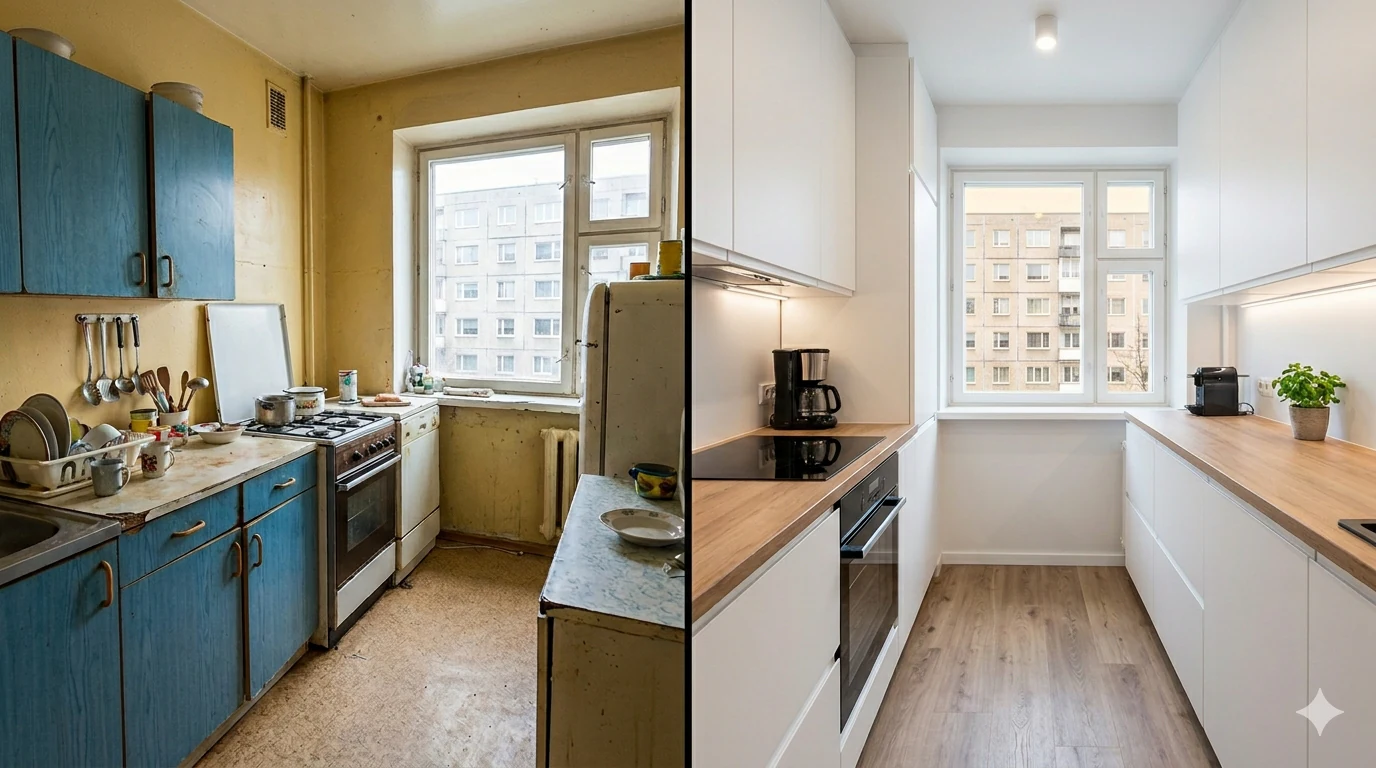
Selling an Old Apartment Without Renovating in 2026 | Guide
Want to sell an old apartment without renovating it first? It is possible. Khrushchevka, Brezhnevka or any apartment that needs work — here is when renovation makes sense and when it does not.
Read more
Selling an apartment without an agent in 2026 | Pros and cons
Should you sell your apartment without a real estate agent? We compare self-selling, listing portals and a direct buyer: costs, time, risks and the best fit.
Read more